In a three-electrode electrochemical system, the platinum counter electrode and the silver/silver chloride reference electrode perform distinct, complementary functions essential for isolating current flow from voltage measurement.
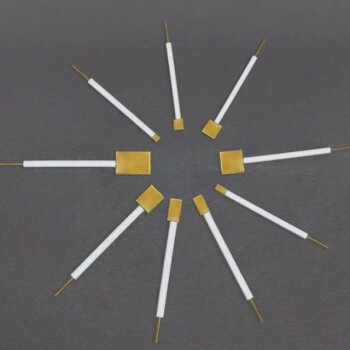
The platinum electrode serves as the counter (or auxiliary) electrode, acting as a conduit to complete the electrical circuit and facilitate electron flow without reacting itself. The silver/silver chloride (Ag/AgCl) electrode functions as the reference electrode, providing a fixed, stable potential baseline against which the working electrode's activity is measured.
The core principle of this system is the decoupling of current and potential. The platinum counter electrode bears the burden of current transmission to drive the reaction, while the Ag/AgCl reference electrode remains isolated from current flow to maintain a precise, unwavering voltage standard.
The Platinum Counter Electrode: The Current Carrier
Completing the Electrical Circuit
The primary role of the platinum electrode is to complete the current loop with the working electrode. Without this path, electricity could not flow through the electrolyte, and the electrochemical reaction on the working electrode could not occur.
Chemical Inertness
Platinum is selected primarily for its superior chemical stability and inertness. It acts strictly as a medium for charge exchange and does not participate in the chemical reactions or dissolve into the electrolyte. This ensures that the results are strictly derived from the working electrode, preventing impurities or side reactions from interfering with the data.
Preventing Polarization
To maintain accuracy, the counter electrode must facilitate redox-balancing reactions efficiently. Platinum's high catalytic activity and conductivity prevent significant polarization (resistance to current flow) at the counter electrode surface, ensuring that the current limitations of the system are dictated only by the sample being tested, not the hardware.
The Ag/AgCl Reference Electrode: The Stability Anchor
Providing a Known Baseline
The Ag/AgCl electrode provides a stable, standardized potential reference point. Because the voltage of the working electrode is relative, it must be measured against a value that does not change. The Ag/AgCl half-cell offers a known reduction potential that remains constant over time.
Isolation from Current
A critical characteristic of the reference electrode is that it does not pass current during the experiment. By remaining chemically static, it avoids the polarization effects that would shift its potential, ensuring the measurements reflect only the changes occurring at the working electrode surface.
Enabling Standardization
Using a standard reference like Ag/AgCl allows researchers to compare results across different experiments and laboratories. It also facilitates the conversion of data to other scales, such as the Reversible Hydrogen Electrode (RHE), which is essential for analyzing efficiencies in applications like photo-electric conversion.
Understanding the Trade-offs
Reference Electrode Contamination
While the Ag/AgCl electrode is robust, it typically relies on an internal electrolyte solution (often saturated KCl). In sensitive experiments, there is a risk of chloride ions leaking from the reference electrode into the main solution, or conversely, the main solution contaminating the reference, potentially drifting the reference potential.
Counter Electrode Surface Area
While platinum is highly conductive, the geometry matters. If the platinum counter electrode (wire, sheet, or mesh) has a smaller surface area than the working electrode, it can become the "bottleneck" of the system. This can limit the current flow and artificially throttle the reaction rate of the working electrode.
Making the Right Choice for Your Goal
To ensure the highest fidelity in your electrochemical data, consider the specific requirements of your experiment when setting up these electrodes.
- If your primary focus is high-precision potential measurement: Ensure your Ag/AgCl reference electrode is properly stored in saturated KCl when not in use to prevent potential drift.
- If your primary focus is high-current experiments: Utilize a platinum mesh or large sheet rather than a simple wire to maximize surface area and prevent the counter electrode from limiting the reaction kinetics.
By respecting the distinct roles of the current-carrying platinum and the potential-holding Ag/AgCl, you ensure that your data reflects the true behavior of your material, not the limitations of your setup.
Summary Table:
| Component | Electrode Type | Primary Function | Material Advantage |
|---|---|---|---|
| Platinum (Pt) | Counter (Auxiliary) | Completes the circuit; facilitates electron flow | High inertness and catalytic activity; prevents polarization |
| Ag/AgCl | Reference | Provides stable potential baseline | Constant voltage; isolated from current to ensure measurement accuracy |
Elevate Your Electrochemical Research with KINTEK
Precise data depends on high-quality components. KINTEK specializes in premium laboratory equipment and consumables, offering a robust selection of electrolytic cells and electrodes designed for demanding research environments. Whether you need high-surface-area platinum mesh for high-current experiments or stable Ag/AgCl reference electrodes for precision potential measurement, our solutions ensure your data reflects the true behavior of your materials.
From high-temperature furnaces and autoclaves to specialized battery research tools, we provide the tools that drive scientific breakthroughs. Contact us today to optimize your lab setup!
Referencias
- S. Sivasankaran, Abdel-baset H. Mekky. Influence of Oxide Dispersions (Al2O3, TiO2, and Y2O3) in CrFeCuMnNi High-Entropy Alloy on Microstructural Changes and Corrosion Resistance. DOI: 10.3390/cryst13040605
Este artículo también se basa en información técnica de Kintek Solution Base de Conocimientos .
Productos relacionados
- Electrodo de Referencia Calomel Plata Cloruro Mercurio Sulfato para Uso en Laboratorio
- Electrodo Electroquímico de Disco Metálico
- Electrodo de lámina de platino para aplicaciones de laboratorio de baterías
- Electrodo de Referencia de Sulfato de Cobre para Uso en Laboratorio
- Electrodo Electrolítico de Grafito en Disco y Varilla de Grafito
La gente también pregunta
- ¿Cuál es la función de un electrodo de referencia? Domina la precisión en la reconstrucción de reactores de tres electrodos
- ¿Cuál es el mantenimiento recomendado para la solución de relleno de un electrodo de referencia? Una guía para lecturas estables y precisas
- ¿Qué electrodo se utiliza como referencia de tierra? Domine la clave para mediciones electroquímicas precisas
- ¿Qué es el electrodo de referencia en potenciometría? La clave para mediciones estables y precisas
- ¿Qué electrodo se utiliza como referencia? Una guía para mediciones electroquímicas precisas