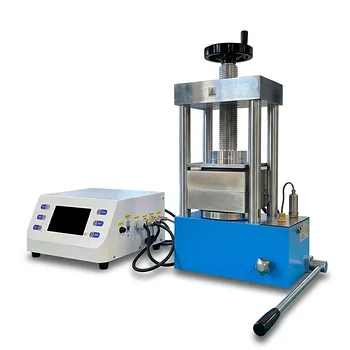
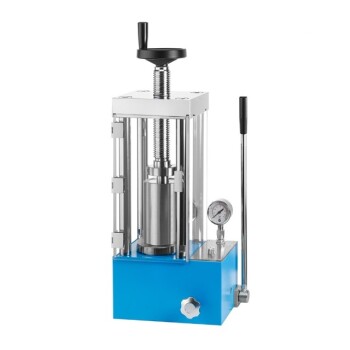
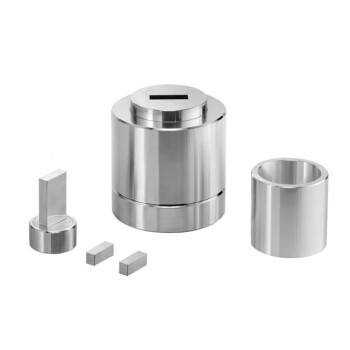
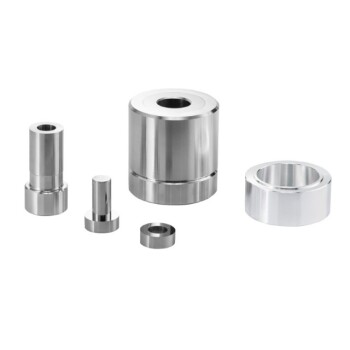
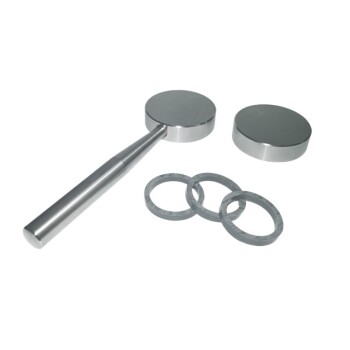
La prensa hidráulica manual de laboratorio se utiliza para convertir el polvo carbonizado suelto de C-(MOF-5/PANI) en una pastilla densa y sólida para pruebas precisas de conductividad. Al aplicar alta presión —a menudo alcanzando los 255 MPa—, la prensa elimina los vacíos de aire y reduce significativamente la resistencia de contacto entre las partículas individuales. Esto garantiza que las mediciones resultantes reflejen la capacidad de transmisión electrónica intrínseca del material en lugar de los huecos de aire o el empaquetamiento suelto del polvo.
Idea Clave: La prensa hidráulica crea una red de percolación densa y uniforme dentro del material compuesto, permitiendo a los investigadores medir la conductividad volumétrica "verdadera" al eliminar la interferencia de la resistencia de contacto entre partículas.
Eliminación de la Resistencia de Contacto y los Vacíos
Establecimiento de una Red de Percolación Continua
Los polvos carbonizados sueltos son intrínsecamente resistivos porque los electrones deben saltar a través de huecos de aire o puntos de contacto deficientes entre las partículas. La prensa hidráulica fuerza estas partículas a unirse, estableciendo una red de percolación estable y continua a lo largo de la muestra.
Reducción de la Interferencia del Aire
El prensado manual hace que las partículas de tamaño micro o nano sufran deformación plástica y se empaqueten estrechamente. Este moldeado físico excluye el aire de la matriz de manera efectiva, evitando que la resistencia atmosférica sesgue los datos finales.
Enfoque en las Propiedades Intrínsecas
Sin la peletización, los datos de conductividad simplemente describirían el "estado de empaquetamiento volumétrico" del polvo. La compresión de alta presión garantiza que la medición revele las propiedades físicas intrínsecas del compuesto carbonizado de MOF/PANI en sí.
Garantizar la Uniformidad Geométrica y de Densidad
Estandarización de Parámetros Físicos
Una prensa hidráulica permite la creación de pastillas con dimensiones geométricas fijas, como un espesor y diámetro específicos. Estas dimensiones precisas son críticas para calcular la resistividad volumétrica y la densidad aparente con precisión en diferentes muestras.
Mantenimiento de una Densidad de Muestra Consistente
El control preciso de la presión asegura que cada muestra de prueba tenga una línea base de densidad uniforme. Esta consistencia es vital para la repetibilidad, permitiendo a los investigadores comparar diferentes formulaciones o temperaturas de carbonización sin que la densidad sea una variable oculta.
Facilitación de Técnicas de Medición Fiables
Se requieren pastillas cilíndricas y densas para métodos de prueba estándar, como la medición de conductividad de cuatro puntas. La forma sólida garantiza un contacto de electrodo estable, lo cual es imposible de lograr de manera fiable con polvos sueltos y cambiantes.
Comprensión de los Compromisos
El Riesgo de la Sobrecompresión
Aplicar una presión excesiva puede provocar el colapso estructural de las marcos MOF delicados o una deformación plástica no deseada. Si la presión es demasiado alta, puede alterar la morfología del material, dando lugar a lecturas de conductividad que no representan el estado de aplicación previsto del material.
Rebote y Fragilidad del Material
Algunos compuestos carbonizados pueden exhibir "rebote" o fractura frágil después de liberar la presión. Esto puede introducir microgrietas que aumentan la resistencia, anulando potencialmente los beneficios de la peletización inicial si la muestra se maneja de forma brusca.
Límites de Calibración de Presión
Las prensas manuales requieren un monitoreo cuidadoso para asegurar que la presión se mantenga constante. Las fluctuaciones durante el ciclo de prensado pueden provocar gradientes de densidad internos, donde la parte superior e inferior de la pastilla tienen diferentes propiedades conductoras.
Cómo Aplicar Esto en Su Investigación
Una peletización exitosa requiere equilibrar la necesidad de densidad con la preservación de la integridad estructural del material.
- Si su enfoque principal es determinar la resistividad volumétrica: Utilice un troquel de alta precisión para asegurar dimensiones geométricas fijas para cada muestra.
- Si su enfoque principal es comparar diferentes cargas de material: Mantenga una presión estrictamente consistente (ej. 255 MPa) en todas las muestras para asegurar que la densidad no sea una variable.
- Si su enfoque principal es preservar la estructura del MOF: Realice un estudio de sensibilidad a la presión para encontrar la presión mínima necesaria para estabilizar la red de percolación sin colapsar los poros.
Al utilizar una prensa hidráulica para estandarizar el estado físico de los compuestos de C-(MOF-5/PANI), los investigadores pueden pasar de datos de polvo inconsistentes a benchmarks de conductividad científicos y reproducibles.
Tabla Resumen:
| Característica | Función en la Peletización | Impacto en las Pruebas de Conductividad |
|---|---|---|
| Alta Presión (255 MPa) | Elimina vacíos de aire y huecos | Reduce la resistencia de contacto para mediciones intrínsecas |
| Fuerza de Compresión | Crea una red de percolación continua | Garantiza una transmisión electrónica estable y fiable |
| Precisión Geométrica | Produce pastillas con dimensiones fijas | Permite el cálculo preciso de la resistividad volumétrica |
| Control de Densidad | Mantiene una densidad de muestra consistente | Asegura la repetibilidad entre diferentes lotes de material |
Eleve la Precisión de Su Investigación con KINTEK
Logre la excelencia científica en sus pruebas de conductividad y síntesis de materiales con el equipamiento de laboratorio de alto rendimiento de KINTEK. Nos especializamos en proporcionar las herramientas de precisión necesarias para transformar polvos brutos en datos fiables, asegurando que su investigación refleje las verdaderas propiedades intrínsecas de sus materiales.
Nuestra cartera integral está diseñada para apoyar cada etapa de su flujo de trabajo:
- Prensas Hidráulicas: Prensas de precisión para pastillas, calientes e isostáticas para la preparación uniforme de muestras.
- Procesamiento Térmico: Hornos de alta temperatura (de mufla, tubo, vacío, CVD y PECVD) para carbonización avanzada.
- Síntesis de Materiales: Reactores de alta presión, autoclaves y celdas electrolíticas.
- Preparación de Muestras: Sistemas de trituración, molienda y tamizado para lograr un tamaño de partícula ideal.
- Esenciales de Laboratorio: Consumibles esenciales incluyendo productos de PTFE, cerámicas y crisoles.
Ya sea que sea un investigador centrado en compuestos de MOF o un gerente de laboratorio optimizando operaciones, KINTEK proporciona la fiabilidad y el soporte técnico que necesita.
¡Contáctenos hoy para encontrar el equipo perfecto para su laboratorio!
Referencias
- Marjetka Savić, Gordana Ćirić‐Marjanović. Carbonization of MOF-5/Polyaniline Composites to N,O-Doped Carbon/ZnO/ZnS and N,O-Doped Carbon/ZnO Composites with High Specific Capacitance, Specific Surface Area and Electrical Conductivity. DOI: 10.3390/ma16031018
Este artículo también se basa en información técnica de Kintek Solution Base de Conocimientos .
Productos relacionados
- Prensa Hidráulica Manual de Laboratorio para Preparación de Pellets
- Prensa Hidráulica Manual de Laboratorio para Preparación de Pastillas
- Prensa Hidráulica de Pellets Automática para Uso en Laboratorio
- Prensa Hidráulica Automática de Laboratorio para Prensa de Pastillas XRF y KBR
- prensa de pellets kbr 2t
La gente también pregunta
- ¿Cuál es la función de una prensa hidráulica de pellets de laboratorio y moldes de acero inoxidable en la fabricación de ánodos de RuO2/NbC?
- ¿Cómo contribuye una prensa hidráulica de laboratorio para pellets a la preparación de preformas de compuestos de matriz de aluminio 2024 reforzadas con bigotes de carburo de silicio (SiCw)?
- ¿Cuál es la importancia de aplicar una presión de 200 MPa con una prensa hidráulica de laboratorio para cerámicas compuestas?
- ¿Cuál es la necesidad de utilizar una prensa hidráulica de pellets de laboratorio en la preparación de pellets de combustible de biomasa? Guía
- ¿Qué papel clave juega una prensa de pastillas de laboratorio en el análisis FTIR? Domina la preparación de muestras de KBr